Six Cup Classic CHEMEX
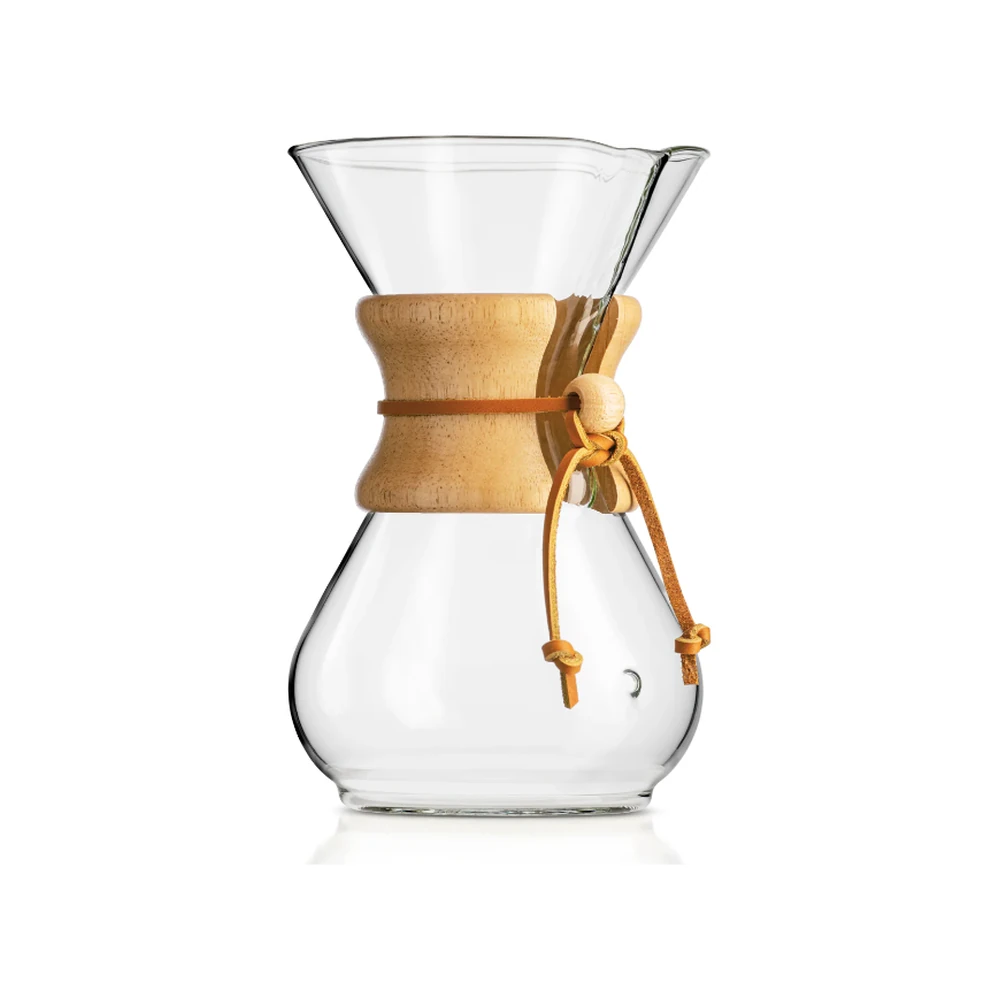
Worth it only if the whole house will wait for it — and its 6 cups are 5-ounce cups, 30 ounces in all.
Thinking of a cup as 8 ounces, one owner puts the consequence plainly — if you need more than about 4 cups, go up a size. What takes longer to check is what the filters cost, whether the glass lasts, and whether the people you drink coffee with will want to wait for it.
We may earn a commission · Why this matters
Manual pour-over in one-piece borosilicate glass, $49.50: 30 ounces at Chemex's 5-ounce cup, proprietary filters extra, worth it only if the household wants the slow ritual.
The argument
Why We Chose the Chemex 6-Cup Classic
Take it apart and there are three materials: one piece of borosilicate glass, a polished wood collar and an insulating leather tie. It is a manual pour-over, so nothing happens until someone pours.
What turns the glass into a system is the paper. Chemex filters are bonded and thicker than the standard filters a drip coffeemaker uses, and the six-cup takes them under four product codes.
The fit
Who'll Love This
It lands in a house where the slowness is the point: one owner says the routine is what slows them down and wakes them up, and a second welcomes it as a deliberate pause in the day. It misses in a house where mornings are rushed, and two owners warn that it will not suit one.
Perfect for someone who
- shares slow mornings with one other person
- is trading a pod machine for a more hands-on brew
- grew up with one and wants the same carafe again
Skip for someone who
- wants the last cup as hot as the first, since owners say the glass does not keep coffee hot
- needs coffee ready the moment they wake up, since there is no automatic setting
- would rather not keep buying the maker's filters
- means to reheat coffee in it, since it is not for stovetop, oven or microwave use
- could not shrug off a broken carafe the warranty will not cover
A manual pour-over style glass coffeemaker, in its encyclopedia entry's words, of a design the Museum of Modern Art holds.
AdventurousHas a point of view
The Verdict
The other person drinking the coffee decides this one.
The other person drinking the coffee decides this one, more than the glass or the price.
The object asks the same things of every house: a few minutes and some patience each morning, proprietary filters, and care with glass whose breakage the maker's warranty excludes. What it gives back is reported rather than measured: the case for the cup rests on buyers' reports, and no independent test we found has checked it. Owners who love the routine and owners who say it does not suit a rushed morning are describing the same carafe.
If everyone who drinks from it wants the slow part, those costs buy a ritual. If one of you wants coffee now, they buy a wait.
The Story
The CHEMEX Story
Chemex's about page places its factory in Massachusetts and says what happens there: each coffeemaker is inspected, polished and hand tied before it is boxed for shipping. Those are finishing steps. Crate & Barrel's listing for item CM-6A, this six-cup, gives the country of origin as Made in Taiwan, and Chemex's own materials page says it sources from both domestic and international locations. Read together, every one of those sentences stays true: it is made in Taiwan and finished in Massachusetts, and neither half is the whole story.
The design is a chemist's. Chemex credits Dr. Peter Schlumbohm with designing and patenting the carafe and with inventing its bonded filters, and the Museum of Modern Art, which holds an older example of the design, quotes his own account of the job he set himself: "A coffeemaker must make coffee." Even his patent count depends on who is counting.
What People Are Saying
Praise goes to what it does to the morning and to the cup: a routine that works like meditation, and coffee one owner found less bitter. Regret goes to the glass itself — how easily it broke, how fast the coffee cooled. Owners with older units add a quieter disappointment: the new glass, they say, is thinner.
"There is no automatic setting so that the coffee is ready when you get up, but the routine of making coffee in the morning with this product is a kind of meditation thing. It makes me slow down, think and wake up."
"If your mornings are rushed like ours are, get another coffeemaker. The Chemex coffeemaker is very slow, especially for making more than one cup of coffee."
"I suggest using the Chemex filters, although they are pricey. Other conical filters can burst or collapse during brewing."
"Thin, fragile glass. No stability. On my fourth use, I lifted out the filter, It tipped over and shattered."
"This is aesthetically pleasing, but does not keep our coffee warm for very long."
"That being said- I did the taste test, and the output is way more robust, and less bitter."
The Moment
The coffee is in, ground coarse as is typically recommended — like kosher salt — and about 130 grams of water has just gone over it. Then nothing happens for about 30 seconds while the grounds bloom. There is nothing to do but wait, with the rest of the water, at 93 to 96 degrees Celsius, still to pour.
That half minute is the whole question.
The Gift Scene
No filters come in the box, so the first cost arrives before the first cup. Five owners on one site said so, one after having to go out and buy some before the carafe could be used at all. From then on the filters are a running cost. Owners call them pricey, unusually expensive, much more expensive than ordinary filters; one who did the division puts them at 2 to 3 cents a cup, and another says they often cost about twice their usual retail price of roughly $8 to $9 per 100 when bought on Amazon.
The second cost is the washing. The wood collar and the leather tie come off to clean the glass, which owners call a pain and one extra step every time. The shape fights back too: one owner who always rinses it with hot water still finds residue building up inside unless it is scrubbed out, says the shape makes that hard, and reports the bottom permanently stained despite regular cleaning. Months in, that is the ownership — a filter bill that keeps coming and a collar that comes off at every wash.
The Aftermath
Plants went into it before any coffee did. One owner's first reaction was to the object rather than the brew: it was so gorgeous, and using it too much risked breaking it.
Who are you buying for?
The worry
That the carafe you give is not the one you remember.
Just Because
Handing one on, the way one owner already did
One owner gave an older Chemex to a daughter and came back for a replacement, then found the new one unstable: it tipped over and shattered on its fourth use. If you are buying one for your grown child, the gesture has a precedent, and so does the disappointment.
An owner has already handed one on, which is the gesture you are making.
Will they manage the method? The maker prints the steps, bloom time included, and two owners say they learned it from videos.
That one was the true classic: heavy glass, with a thick bottom, giving it stability.
The worry
Too slow for a morning with somewhere to be.
Just Because
She would have to want the slow mornings too
Buying it for her means buying a morning the two of you share. One owner whose household mornings are rushed tells readers to get another coffeemaker, because it is very slow, especially for more than one cup, and that owner is the case for asking her first.
If she already likes making coffee by hand, it gives that habit a shared object that is as much for looking at as for brewing.
Enough for two? It holds 30 ounces, six of the maker's 5-ounce cups, and the maker aims this size at couples or small households.
It provides a nice opportunity for an intentional slow living moment during the day.
The worry
Handing him a morning job instead of a morning ritual.
Just Because
Patience before his first cup, every morning
The catch comes from a five-star owner, and it is worth reading before you wrap it. The question is whether his mornings have a few minutes of patience in them, not whether he likes good coffee.
What one owner calls the downside, the patience, is the appeal when he wants a pause in the morning.
What does he need besides the carafe? Chemex's bonded filters, then coffee ground coarse and hot water, as the method typically calls for — nothing to plug in.
The downside is if you are in a hurry or you simply don't have time in the morning, this will not work for you as you have to have a few minutes and, most important, some patience.
The worry
A showpiece that never gets used for coffee.
Just Because
Admired as design; every cup made by hand
Its place in a museum collection is a fact about the form, not a reason to buy it: the coffee still has to be made by hand, slowly, every time.
It is kept for how it looks as well as for what it makes, which is why it suits a kitchen with nothing missing.
They own a coffee maker already? This is less a replacement than a different habit: a manual pour-over, made one pour at a time.
This is a great decoration piece and definitely asks for a lot of attention.
The bottom line
Right for a house where every coffee drinker wants the wait; wrong wherever someone needs coffee fast or kept hot, won't commit to the maker's filters, or can't risk glass the warranty excludes.
Where it's made
Taiwan, finished in Massachusetts
Made in Taiwan according to the country-of-origin field on Crate & Barrel's listing for item CM-6A; inspected, polished and hand tied at Chemex's Massachusetts factory, in the maker's words.
Chemex says the carafe drew on the non-porous labware its designer used for chemistry experiments; a museum curator names the Erlenmeyer flask.
From our research
An aside for provenance fans: the museum's own record credits its example to a gift of Lewis & Conger, not to the designer, and the same museum once showed Chemex beside Braun as two design programs.
The owners who say the glass got thinner are the ones with an older Chemex to compare: one had an identical unit over 25 years old that never gave trouble, then saw a newer one break after 2 weeks; another remembers heavy glass with a thick bottom.
Chemex says in writing that it does not warranty against traumatic breakage, and 7 owners in the critical reviews report the glass breaking or cracking — one while the coffee was brewing. Coverage also needs proof of purchase from an authorised seller.
Not for stovetop, oven or microwave use, whatever listing copy says about reheating. For washing, the maker allows the dishwasher and a retailer says hand-wash, and the two do not agree.
The only head-to-head we found is an owner's own: against a pod system, roughly twice the grounds and a lot more effort, then a taste test that came out more robust and less bitter. One person's test, in a promoted review; not a measurement.
The score
Institutions that do not copy each other make the design case: the Museum of Modern Art holds an example and traces its form to laboratory glassware, and an encyclopedia records Illinois Institute of Technology designers calling it "one of the best-designed products of modern times."
The surprises are in the paperwork: a museum credit line naming Lewis & Conger rather than the designer; patent counts of over 300 from Chemex and over 3,000 on an earlier museum label; and a retailer's Made in Taiwan origin field against Chemex's Massachusetts factory.
One routine carries this score: a 30-second bloom and a slow pour that one owner calls a kind of meditation, and that two others say rule it out for anyone in a hurry.
4.8 stars from 6,973 ratings on Amazon's six-cup listing
No brand reply to a critic on any of three review sites, no pasted community thread or independent video, and two visual checks left unscored: those gaps hold confidence at 75 and so trust at 7.5.
The evidence
Why we trust this
Of the three review pools, only the Amazon listing for this exact item, with verified-purchase badges, supplies this page's rating and review count. Crate & Barrel's 512 reviews pool sizes and collar colours and enter every reviewer in a gift-card draw. Every review Target shows was written on another site under a promotion, 12 of them on one platform, 10 of those inside about five weeks.
The research behind this
30 verified claims from this product's record - last verified September 22, 2026
Rating and review data from
- Amazon Primary
- Crate & Barrel
- Target
Quick facts
- Price
- $49.50
- Brand
- CHEMEX
- Category
- Kitchen & Dining
- Aesthetic
- Modern Classic
- Great For
- Just Because
- Gift Type
- Adventurous
- Type
- Consumable
Value
$49.50 for the carafe, plus the maker's filters at $11.00 per 100; one owner comparing it with a pod system found it used roughly twice the grounds.
Common Questions
How many cups does a 6-cup Chemex actually make?
Six Chemex cups, which is 30 ounces: the maker counts a cup as 5 ounces, not 8. One owner who counts 8 ounces to a cup advises the bigger size if you need more than about 4 cups.
Do you have to use Chemex filters or will any filter work?
Owners disagree, and no test we found settles it. One says a filter from an old machine worked great; another says off-brand filters are not bonded; a third says other conical filters can burst or collapse mid-brew. The maker sells its own, 100 to a pack, and five owners report none come in the box.
Is the Chemex glass thinner than it used to be?
Owners with older units say so. One compares a new carafe with an older one remembered as heavy glass with a thick bottom; another had an identical unit over 25 years old that never gave trouble, then saw a newer one break after 2 weeks. No source measures the glass or dates a change.
Is the Chemex made in Taiwan?
Yes, according to the country-of-origin field on Crate & Barrel's listing for item CM-6A, and it is finished in Massachusetts, where the maker says each coffeemaker is inspected, polished and hand tied. The maker also says it sources materials domestically and internationally.
Can you keep a Chemex warm on the stove?
No. A retailer's specification block says it is not for microwave, oven or stovetop use. Listing copy says the coffee can be refrigerated and reheated, and one owner relays that the instructions allow a glass stovetop, but the prohibition is the instruction to follow.
Is a Chemex worth it if only one of you wants the ritual?
Owners split on the ritual itself: one calls the routine a kind of meditation, two say it will not suit a rushed household. A study of couples found a shared ritual's benefits accrue only when both partners agree it is a ritual — a finding about couples, not coffee.
More questions we have answered
No more questions? Buy it for $49.50
How We Validated This
Last updated- Official CHEMEX CHEMEX CHEMEX CHEMEX
- Retailer Amazon Amazon Crate & Barrel Crate & Barrel Target
- Source The Museum of Modern Art The Museum of Modern Art Wikipedia Journal of the Association for Consumer Research
AI found these sources, read them and wrote this page. Mark van Oosterwijck, who founded SleekNova, approved this product before it was researched, decides the rules the AI works under, and published this page. No brand paid to be reviewed or scored here.
Mark van Oosterwijck stands behind this verdict