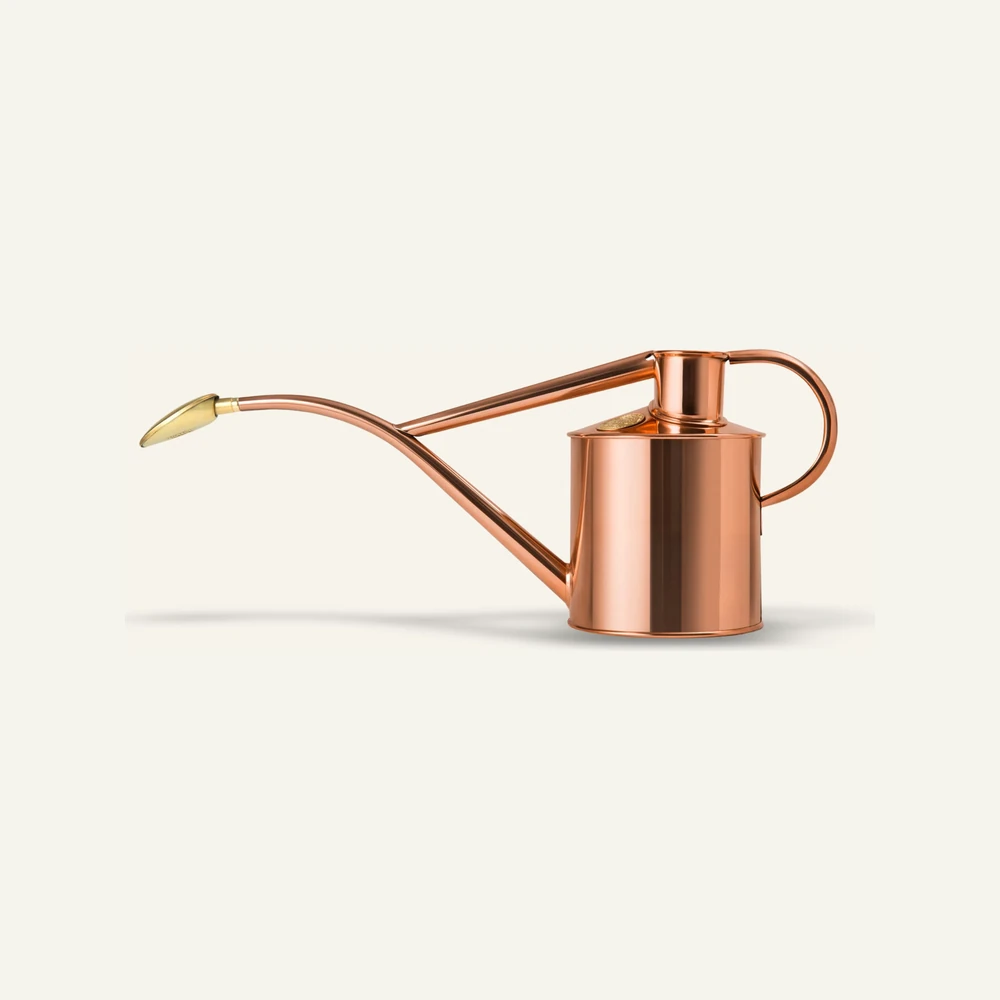
The Rowley Ripple Copper Two Pint
Haws sells this rose for seedlings. Its own storefront carries the buyer who says it drowned his.
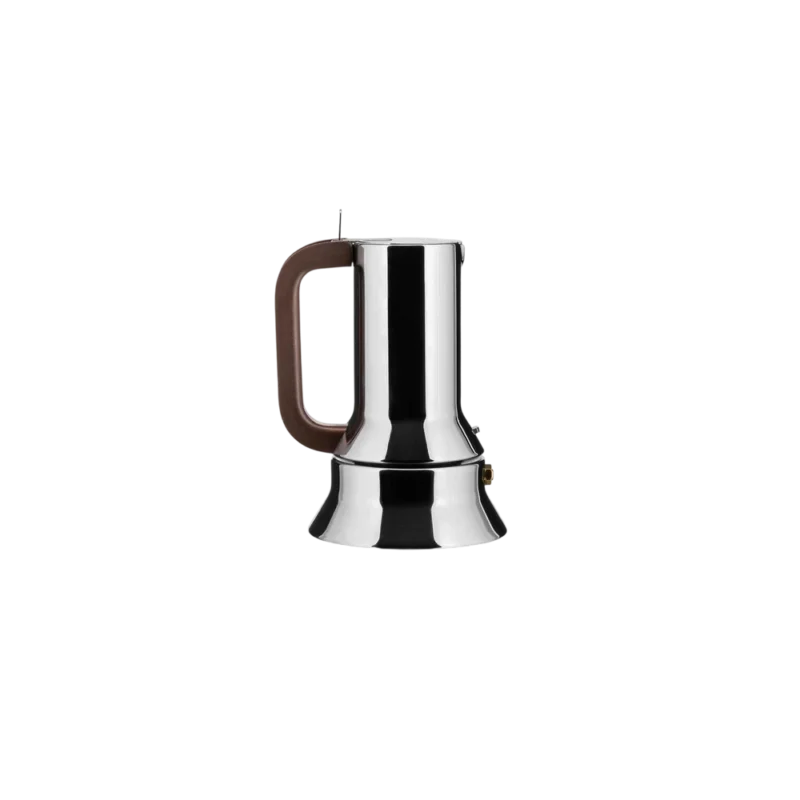
The argument here is geometry, and the maker states it as cause and consequence: the spout curves so the outlet points downward, so you set the aim before you start pouring and it holds as the can empties.
That is the maker on its own product. What makes it worth reading is three buyers on three surfaces, two away from Haws's own store, naming a problem and reporting the outcome: plants at the back of a deep windowsill, and it does not spill.
Solid copper sheet, ninety pounds at the maker's store. The real choice is between the two things it can do.
We don't earn if you buy · Why this matters
A two-pint solid copper indoor watering can, GBP 90, with a curved spout you aim before pouring and a brass rose for seedlings.
The argument
Why We Chose the The Rowley Ripple Copper Two Pint
One can, two jobs, and you choose between them by fitting a part or leaving it off. With the rose removed you get a controlled direct stream for everyday pot watering. Fit the supplied Baby Oval Rose and it switches to a fine spray, which the maker suits to seeds and seedlings, where a direct stream would disturb the soil.
The maker calls that spray the finest droplets in the range. It does not say which range, and that ambiguity is in the wording Haws chose, not in a measurement.
The rose in the box is a Baby Brass Oval Rose, and it is the only one this can accepts. So the two modes are the whole choice. There is no second rose to buy later that changes what this object does.
The spout is why the stream lands where you aim it. The rose is the mode the maker fits for the seedlings a stream would disturb. Which of the two you need more depends entirely on what is sitting on your windowsill.
The fit
Who'll Love This
There is a piece of research about gift giving that is useful here, and it is not about the person receiving the gift at all. It is about you.
Researchers looked at real gift exchanges and then tested the same question directly. What they found is that where you stand changes what you reach for. Buy for someone you have more standing than, and you optimise for whether the thing will actually get used: practical, functional, does a job. Buy for someone you have less standing than, and you reach for the thing that will impress. The part worth keeping is about the person on the other end: what they wanted did not move at all depending on who was buying. The bend is entirely on your side.
So the safe gift, on that finding, is the one that answers both questions at once. You do not have to know which way your own judgment is bending, because a thing that is genuinely useful and genuinely good to look at survives the bend either way.
This can is one of those, and the evidence for it is buyers reaching for both halves in one breath, unprompted by us. A verified customer calls it a work of art that is functional and frames it as a present for a keen gardener. Another says he chose it because it is beautiful and functional. A third says it is almost too good to use, and then, in the next sentence, that filled with water it really comes into its own and pours beautifully and gently. A UK stockist reaches for stylish and functional. A US retailer reaches for practical and heirloom-worthy.
So the person this fits is a keen gardener, in one buyer's words and in a stockist's words about its whole Haws range. Who it is wrong for is a shorter list, and it is a real one.
Perfect for someone who
- keeps houseplants and waters them by hand
- starts seeds and seedlings indoors
- has plants in places a jug cannot reach
- would notice a tool that is also an object
Skip for someone who
- wants one fill to do the whole house, because this holds two pints
- expects a bigger can, because one buyer found it smaller than she expected
- would be as happy with the painted version, which the writer who praises this one most calls the same size and shape, just as well built, and a much better price
- wants a can made for the garden, since the maker designates this one indoor
An indoor plant watering can, as the maker and two retailers designate it.
Statement PieceRequires knowing their taste
The Verdict
This is a small and precise watering can.
This is a small and precise watering can, and an expensive one, whose one design argument is confirmed by the people who bought it for that argument, and whose material advantage is aesthetic rather than functional.
Both halves of that sentence carry weight, and the second one is not ours. The only independent long-term owner in this record says plainly that the copper has no tangible benefit over the plastic can he had before, and that the material is still the main draw for him. He is not conflicted about it and neither is this page.
You are buying a mechanism that works and a surface you will like looking at, and the surface is most of what the price is for.
An object with an argument this specific usually has a history behind it. This one does, and it is not the history the marketing leads with.
The Story
The Haws Story
Haws publishes its own worst chapter, which is the most surprising thing this research turned up.
The company was established in 1886. Its own history page then says that in 1976 the business was sold to Elliott Limited of Walsall, that the new owner lacked the expertise to reignite the brand, and that during the late 1970s recession the company went under and the workshop went quiet once again. The same page says Haws as it is known today began in 1982, when the company was bought by Eclipse Sprayers, run by a father and son team, John and David Pennock, based in Smethwick, West Midlands. It says the people who restarted it began a long journey towards getting the build of the cans back to what it had been, and rekindling the reputation.
That is a company writing down that it had lost the thing it sells.
The same maker also states it is the world's oldest manufacturer of watering cans. Both statements sit on the same website, and this page states them together or not at all. An unbroken line is not what that history page describes.
Today it is run by David Pennock's son Andy.
None of this reaches the can in your basket as a design claim. The maker's own narrowest sentence about its 1886 patent names a different range, the Warley Fall, as the example, and another maker page names that same range as the one most closely resembling the original design. This model's name was created in a rebrand within the last decade, by the design agency that says so in its own award entry.
Which is a good story about a company. Whether it is a good watering can is a question only its owners can answer.
What People Are Saying
The review evidence here is thin and genuinely divided, in that order.
The largest single pool is the review widget Haws hosts itself. Away from the maker the numbers move: one US retailer publishes a single review its own platform labels incentivized, and its sibling storefront publishes three split between one star and five.
Three separate things, not one: the rose at its stated job, the condition one can arrived in, and a design gap named inside a five-star. The sharpest of the three is on Haws's storefront.
"This copper can is truly beautiful. I needed a watering can that could reach to small plants at the back of a deep windowsill without spilling. This does NOT spill. And the price was great. So glad I got it."
"I love this can! Great size to make it around all the houseplants with less refilling. It would be the best if there was a little hook for the rose, but that’s really such a small detail!"
"I wanted to be able to water seedlings without disturbing the roots with too much water. The Rowey Ripple Copper watering can sounded ideal. Unfortunately the rose that came with the can wasn't able to do the job. It dripped very badly when in use- drowning my seedlings with far too much water."
"How does an expensive brand new item have oxidation and scratches all over? It’s really not acceptable"
Recognition
Featured in New York Magazine, The Strategist
“I am bestowing the honor upon Haws's copper watering can, a 2018 purchase”
The Moment
Here is what a year of it looks like, from the one person who reported it.
In the year he had his, the copper faded from what he calls off-puttingly clean and gleaming to a state that makes the can look like some family heirloom he had owned far longer. He had written about it a year earlier, less hedged, saying it is gleaming when you first get it, like a new leather jacket, but that it soon starts to develop its signature patina.
That is the object getting better rather than wearing out, and it is why a can like this lives on a surface instead of under a sink. The maker calls the change natural, says it does not affect how the can pours, and says occasional polishing brings the brightness back if you would rather have it. So it is not a one-way door.
The daily version is small and repeated: a two-pint can that sits out, gets picked up, aims where you point it, and goes back down. The only named expert in this record who speaks about watering cans as a category rather than about this one says a watering can should look as good as possible, and that it is so much easier when you do not have to hide it all the time.
None of that is the moment you are actually buying. That one is the handover.
The Gift Scene
It arrives ready to give. The maker states that every Haws can is packaged in a custom-designed box made from recycled cardboard, sized to protect the can, and designed so it can be given without anything else needed. A UK stockist calls it handsomely packaged in a gift box and a US retailer calls the box gift-ready. The rose is tucked inside the can's box rather than shipped separately, so there is one parcel and one thing to open.
Two buyers describe exactly that arrival. One bought it as a copper wedding anniversary gift and wrote his review before opening it, saying it arrived on time and well packaged. One chose it for an eightieth birthday and reports the packaging and the delivery alongside the object.
And the risk you are taking, because it is real and it lands at exactly this moment: one buyer opened his and found oxidation and scratches on a new item. Four photographs sit with that review, and the retailer's public answer was that it is not the standard they aim for. Copper shows handling. If this is going straight into wrapping paper, open the box first.
Whether it is the right moment depends entirely on who is standing there.
Who are you buying for?
The worry
It looks like an ornament, and two owners said as much. A gift she puts on a shelf is not the same as a gift she reaches for.
Birthday
It lands if she keeps plants, because what it is good at shows every time she uses it
The one relationship here carried by somebody actually doing it, and he wrote down what she said.
A verified customer bought this exact can as a birthday present for his wife, and what he passes on is her verdict on it, together with how it looks and how it pours.
Notice what he reports: the look and the pour, in one sentence. The object does not ask her to choose between an ornament and a tool.
Beautiful is not the argument here. What she gets on day one is a can that puts the water where she points it, and a second mode the maker supplies for seeds and seedlings. Both keep showing up every time she picks it up, and that is what turns an object she was given into an object she reaches for.
It is two pints. If she waters a lot of plants in one go she will refill, and one buyer said exactly that: it is not a big can, and she is not sure it will water many plants. And the painted version is the same object at a much lower price.
I bought this as a birthday present for my wife and she honestly says it's one of the best gifts ever (along with a Bell Tent and our children 🤔). Anyway looks lovely, pours smoothly and is a round great. Buy it!!
The worry
Buying a grown child a better version of a tool they already own can read as a note about how they were managing with the old one.
Birthday
It works because it is the version of a thing they already own, not a suggestion
The record's own case here is second-hand, and this page keeps it that way.
A buyer purchased it as a birthday gift for her daughter-in-law, and everything she reports about the object is what her daughter-in-law told her: that she absolutely loved it, and called it a very practical accessory to her kitchen that looked great and was obviously very useful.
That is relayed speech and it stays relayed. What it evidences is the shape of the gift in this direction: an upgrade to an object already in daily use, in a kitchen, described secondhand and in her own words.
Your adult child may already own a watering can. This is not a first one and does not pretend to be. What it adds is a spout with a stated reason, a second mode in the box, and a body that changes with use rather than scuffing. Those are the differences a person who already waters plants can actually tell.
The can already in the cupboard may be one they like, and the maker itself names the two properties on which its metal cans lose: plastic proved popular with gardeners wanting a lighter, lower-maintenance alternative to metal, and still does.
The worry
Someone who gardens seriously already owns watering cans, probably several, and probably one they like.
Birthday
A keen gardener probably does own one. That is the argument, not the objection
So the gift is not an upgrade, and pretending otherwise is how this one goes wrong.
The gap it fills is not capability. It is the difference between a tool that does the job and a tool they would rather look at while it does it.
For somebody who already owns what works, that difference is all there is left to give.
And they are the one who can tell. A person who waters plants every day would notice whether the water goes where it was aimed, and a giver cannot test that from outside.
For somebody who owns every tool already, the honest frame is that the copper does none of the work. It changes what the work looks like, and what is being given here is a better object, not a better tool.
I was searching the internet for a small watering can to water my greenhouse seedlings when I came across this little beauty. When it arrived I was not disappointed. It is stunning, almost too good to use. However, filled with water it really comes into its own. It pours beautifully and gently. Just what I wanted. Thank you Haws.
The bottom line
If the person you are buying for would notice where the water lands, this is the can, with the seller's own worst review still readable. If they would not notice, buy the painted one and keep the difference.

Where it's made
Smethwick, West Midlands
The maker's predominant wording for its own workshop, and the one a non-maker carrier repeats. Its own pages also say Birmingham, and Smethwick, Birmingham. This page does not reconcile them.
From our research
The brass badge on a Haws can shows leafy branches of a fruiting hawthorn, and the fruit itself is called haws. The maker states the fruit's name. It does not say the company name came from it, and neither does this page.
Usable if you ever inherit one. The maker publishes how to date its own old cans by the badge: a can carrying the Clapton Works, Bishops Stortford medallion was made after 1925 and before the 1950s, when the business was sold and relocated.
The score
One buyer says it is well worth it just for looks alone. Another calls it classic and gorgeous and reports no use at all. Two sellers warn buyers in their own listings that hand-making can leave visible variation. Everyone here bought one or sells one.
A landscape architect whose antique tools were shown at the Met owns about a dozen Haws cans, one from the fifties he says still works. Two houseplant authors are reported to use this exact copper can daily. Both reports come from one writer, not from a survey.
Six buyers call it a gift in their own words, and four name the occasion: three birthdays, one an eightieth, and a wedding anniversary the buyer marked by its material. The maker builds every can's box to be given with nothing added. The gift case here is customer reviews, not a guess.
Verified Customer markings on most rows of the review set Haws publishes
Trust sits low because the evidence layer is thin, not because the object disappointed anybody. One pool carries half the reviews, two sellers label theirs as incentivized, and the one video in the record comes from a channel that sells it. The other three are about the can.
The evidence
Why we trust this
What verification found, and what it did not. The maker hosts a product-level review set, most of it carrying a Verified Customer marking, and the identical set sits on its US site, so it is one pool rather than two. Four other sellers carry reviews, two labelling theirs as incentivized. On the three listings whose images were read, customer photographs sit on exactly one review, the one-star. No unaffiliated video in this record: the only video source sells what it describes.
The research behind this
20 verified claims from this product's record - last verified August 25, 2026
Rating and review data from
- Haws Primary
- Terrain
- AnthroHome
Quick facts
- Price
- $90
- Brand
- Haws
- Category
- Planters & Vases
- Aesthetic
- Artisan Craft
- Great For
- Birthday
- Gift Type
- Statement Piece
- Type
- Keepsake
Value
GBP 90 at the maker's UK store. The same model in painted metal costs much less and is the same size and shape.
Common Questions
Indoor or outdoor?
The maker designates it an indoor can, and its sellers do not agree with each other. One US retailer lists it for indoor or outdoor use and then tells you to store it indoors when not in use. A reseller allows limited outdoor use. Two other sellers call it indoor. Two customers on the maker's review widget place theirs outdoors.
What the copper does over time?
The maker says the polished surface will develop a patina with handling and moisture. It calls that a natural surface change, says it leaves the pour alone, and says occasional polishing will restore brightness if you prefer it.
Does the rose suit seedlings?
The maker sells the supplied rose for exactly that. A verified customer on Haws's own product page reports it dripped badly in use and drowned his seedlings with far too much water. A named interior plant designer describes an even spread that mimics rainfall, for plants in larger pots. Nothing here settles it.
What two pints waters?
Two pints is one litre. One buyer reports it arrived smaller than she pictured and doubts it will water many plants. Another reports the size is just right for seedlings and not too heavy to lift, and a third that it gets her round all the houseplants with less refilling. It suits small pots and seedlings rather than a whole house in one fill.
Copper or the painted version?
The magazine writer who recommends the copper one says he had a hard time deciding against the painted version: same size, same shape, built as well, and costing far less. He also says the copper does nothing for him that the plastic can before it did not. The copper is the draw, not the function.
What research says about gifts?
One study of real gift exchanges plus two experiments found the pull sits on the buyer's side. With more standing you go for whether the thing will be used; with less you go for whether it will impress. What the receiver wanted stayed put either way, so a thing that is both is the safe answer.
More questions we have answered
No more questions? Buy it for $90
How We Validated This
Last updated- Official Haws product page Haws: The history of Haws
- Press New York Magazine, The Strategist
- Retailer Bloomist product page Etsy: MandeluGarden listing AnthroHome product page
AI found these sources, read them and wrote this page. Mark van Oosterwijck, who founded SleekNova, approved this product before it was researched, decides the rules the AI works under, and published this page. No brand paid to be reviewed or scored here.
Mark van Oosterwijck stands behind this verdict