248,000 Followers and Not One Review
A vase that does not hold water, sold with a bag for the stems. Ten colours, none of them photographed by anyone who owns one.
Did not pass
101 Copenhagen has distributors in seven countries: the United States, Canada, Japan, Australia, New Zealand, China, and Taiwan. Sales agents span Northern Europe, the United Kingdom, Western Europe, Eastern Europe, Southern Europe, the Middle East, and Southeast Asia.
The brand shows at Maison & Objet in Paris, sells through Farfetch, and has over a hundred products listed on 1stDibs through Galerie Philia.
Their signature product, the Sphere Vase Bubl, is stocked by at least twelve authorized retailers. We checked five of them for customer reviews and found nothing. Not a thin review section. Not a mixed reception. Nothing at all.
We ran the Sphere Vase Bubl (Medio) through our full verification. The design passed. The trust did not.
The Vase
101 Copenhagen was founded in 2017 by designers Kristian Sofus Hansen, Tommy Hyldahl, and Nicolaj Noeddesbo, with offices on the third and fourth floors of Oestergade 17 in central Copenhagen and a warehouse in Horsens, Denmark.
They launched their first collection at Maison & Objet in Paris. Gessato, the design publication based in the Catskills, titled its brand profile “Danish Product Design At Its Finest.”
The Sphere Vase was their first ceramic design. It became the collection they describe as “synonymous with the visual language and the signature series of 101 Copenhagen.”
The Bubl variant, named for its spherical front profile that flattens when viewed from the side, comes in five sizes, from the Mini at 39 euros to the Giant at 999. The Medio, the one we evaluated, sits in the middle at 49 euros in their EU shop, or $70 through the authorized US dealer KANSO.
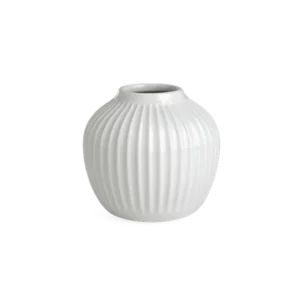
Each vase is hand-glazed ceramic, developed in collaboration with skilled ceramists. The finish uses faded earth tones inspired by ancient Chinese vases, and the brand emphasizes the “precise contrast between the smooth shapes and sharp edges.”
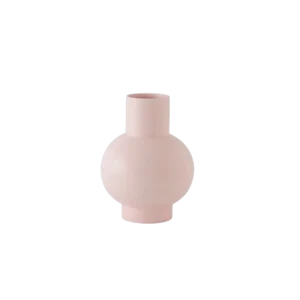
Because each piece is glazed individually, colors vary from one vase to the next. The Medio is available in ten colors, from Bone White to Terracotta to Coffee.
The vase is not waterproof. A flower bag for fresh stems is included. Despite the hand glazing, that bag is the maker’s own answer to whether a decorative vase can hold water, and a glass or jar fitted inside does the same work for any vase whose line says no.
Where We Looked
We checked the product pages of five retailers: KANSO, Danish Design Store, Connox, the brand’s own EU webshop, and Thingtesting.
KANSO, an authorized US dealer with 312 store-level reviews, carries the Medio at $70 with an estimated ship date. No product reviews.
Danish Design Store lists all five sizes with prices from $95 to $195 for the US market. No product reviews.
Connox, a major European design retailer, carries the Mini at 39 euros and lists the manufacturer as 101 Copenhagen ApS. No product reviews.
The brand’s own Shopify store sells the Medio at 49 euros and offers archive-sale pricing on discontinued colors. No review functionality visible.
Thingtesting has a brand page, unclaimed, that reads: “101 Copenhagen is new to Thingtesting. Write the first review.”
We searched for the brand on Trustpilot. No page exists. We searched Amazon. No listing for the Sphere Vase. We searched Reddit for any discussion of 101 Copenhagen. Nothing surfaced.
We searched for press reviews beyond the Gessato profile. We found product descriptions across retailers and gallery listings, but no independent assessment of the vase from a customer, critic, or community.
The brand has 248,000 followers on Instagram. It is registered under Danish VAT number DK40058966. The institutional infrastructure is real and verifiable. The consumer record is empty.
The Score
GLOW scored 9. The sculptural ceramic form, with its hand-glazed ornate edge detailing and faded earth tones, photographs as sculpture before it reads as a vase. Each piece being unique adds to the visual interest.
WOW scored 8. A Danish brand fusing Scandinavian minimalism with ancient Chinese vase forms is, to our eye, a genuine discovery, though the brand’s 248,000 Instagram followers and presence on Farfetch suggest it is not entirely unknown.
MOMENT scored 8. The ceramic has weight and texture. The vase sits on a shelf and transforms the surface it occupies. For a gift, it communicates intention.
Trust scored 3.0. Our confidence methodology reached 30 out of 100. Platform integrity scored zero because no review platform exists for this product on any retailer. Review volume scored zero. Visual proof (customer photography) scored zero. Sentiment consistency could not be assessed.
External echo scored 15 out of 20, reflecting the Gessato editorial, the Maison & Objet exhibitor status, and the Instagram following.
We applied the Brand Trust Protocol, which adds institutional validation points for brands with significant retail and press presence but no consumer reviews. Even with that adjustment, the confidence score reached only 30.
The math: (9 x 0.25) + (8 x 0.35) + (8 x 0.25) + (3.0 x 0.15) = 7.50. That falls below our 8.0 threshold.
But the deciding number is the trust floor. We set it at 4.0 because a recommendation without verified consumer evidence is not a recommendation we can stand behind. At 3.0, the Sphere Vase sits below that line.
The Pattern
This is not a case of a small maker who has not yet found its audience. 101 Copenhagen has found its audience. The audience is the trade: retailers, galleries, agents, design publications.
The brand launched at the world’s largest design fair, built a distribution network spanning seven countries, and attracted a quarter-million Instagram followers in under a decade.
What has not happened is the other half of the loop. The people who actually buy the vase, carry it home, and set it on a shelf have not spoken. Not once, on any platform we could find.
That is unusual. Brands with far smaller distribution footprints routinely accumulate dozens of reviews. The absence here may reflect the brand’s sales model (primarily B2B through agents and trade accounts rather than direct-to-consumer) or the nature of the product (decorative ceramics generate fewer reviews than functional items).
We do not know. We only know what we found, which is nothing.
What Would Change
The design is not in question. Neither is the craftsmanship, the institutional validation, or the global reach.
What our system needs is verified buyer reviews, on any platform, from people who own the vase. A broader base of consumer evidence, across more than one source, would shift the confidence score and likely clear the trust floor.
The trade world has endorsed this brand thoroughly. We are waiting on the people who live with the product.