The $32,000 Sculptor’s Design You Pour Water From at $470
Made the cut
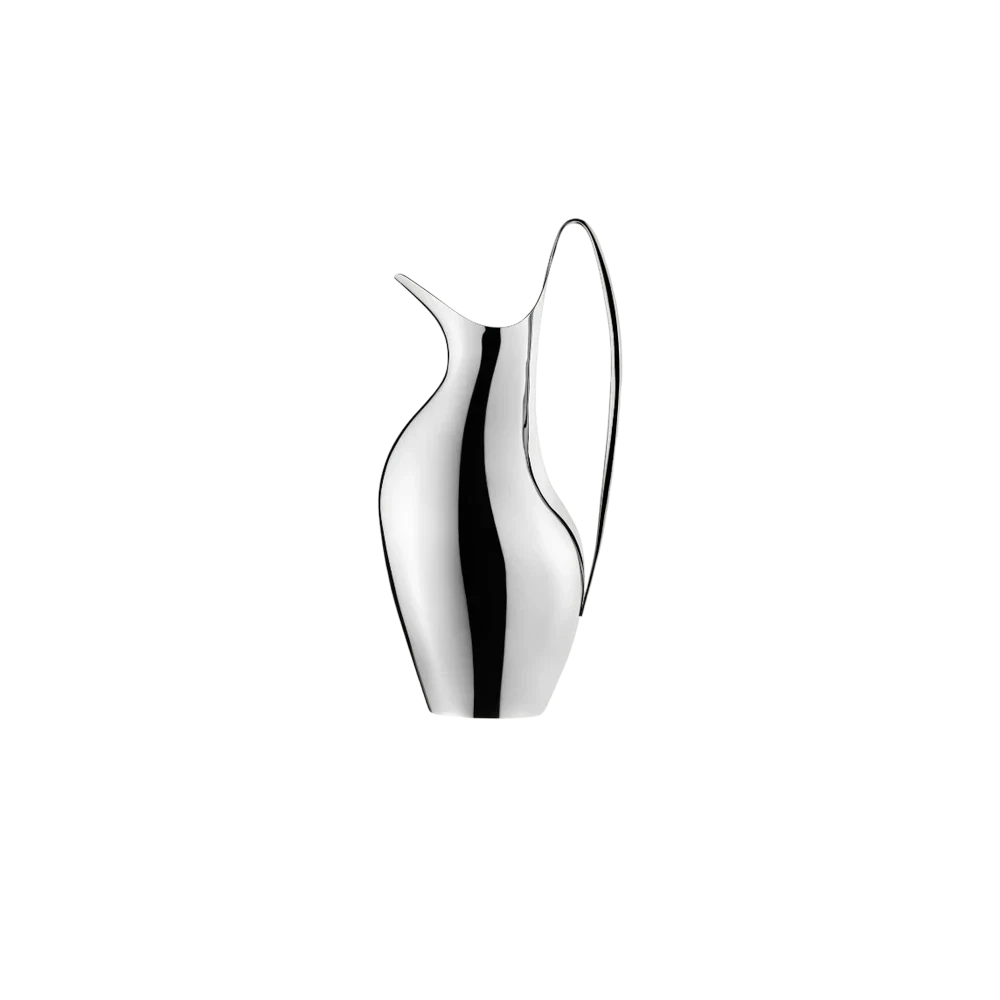
We scored the Georg Jensen Koppel Pitcher 8.3 out of 10.
That number matters less than what we found behind it: the 1952 design in sterling silver retails at $32,000 on Georg Jensen’s website. The stainless steel version is $470. Same sculptor. Same 1952 design.
We spent our research verifying whether that gap holds up, and what it means for someone spending $470 on a pitcher as a gift.
A Sculptor, Not a Product Designer
Henning Koppel was a sculptor. Because of his Jewish background, he had to seek refuge in Sweden during World War II.
The pitcher came in 1952: a sculptor’s spatial thinking applied to hollowware.
We scored WOW at 8 out of 10. The reason is provenance depth. Koppel won three consecutive Milan Triennial gold medals in 1951, 1954, and 1957. His work is exhibited at MoMA and Designmuseum Danmark.
The distance between a brand’s name and the story of one of its pieces is what WOW measures.
Why Mirror-Polished Steel Scores 9
GLOW measures visual and sensory qualities. We gave it 9 out of 10.
Mirror-polished steel captures light in a way matte ceramic and brushed metal cannot. The 1952 form photographs as well today as it did in 1952. The pitcher changes appearance with every surface it sits on and every shift in light.
Two identical halves of steel are shaped onto a mould and soldered together, producing the seamless organic silhouette nicknamed “the pregnant duck.” No visible seams despite being constructed from two pieces.
In 2009, Georg Jensen reissued the design in mirror-polished stainless steel. The material changed. The sculptor’s intent did not.
The Gift Moment We Scored
MOMENT scored 9 out of 10.
The Georg Jensen box alone signals intent. Inside, mirror-polished steel reflects the room before the pitcher is lifted. The weight registers immediately: solid stainless steel. The handle loops upward past the beak-like spout in a single unbroken arc.
What earned the 9 is what happens after unwrapping. Reviewers describe it as pitcher and decorative object; we would add carafe and vase. It moves between roles without being stored.
Among kitchen and dining gifts, this one earns counter space because each use is different and the object stays visible between them.
What We Verified (and Where Trust Fell Short)
TRUST scored 6.5 out of 10. That is our lowest dimension for this product, and we want to explain why.
Georg Jensen was founded in 1904. Koppel’s Milan Triennial wins, his wartime exile, his partnership with Georg Jensen, all verified through multiple independent sources. The pitcher carries Amazon Verified Purchase reviews at 4.5 stars. Trustpilot shows 3,632 company-level reviews at 4.5 stars.
The 6.5 reflects specific gaps. Georg Jensen’s own product page carries zero on-site reviews for the stainless Koppel. Manufacturing origin for the stainless pitcher is not specified anywhere we could find.
Our confidence score landed at 65, which we label “good” but not “high.” We publish this because transparency about limitations is the point of the Lab.
Who This Matches
We matched this to wives, husbands, and moms as primary gift recipients, plus the “has everything” profile.
The Koppel works for anniversaries, milestone birthdays, weddings, and housewarmings. It fits the Scandinavian design sensibility and rewards buyers who value provenance over novelty.
Skip this if the recipient minds wiping fingerprints off mirror-polished steel daily, wants insulated drinkware, or treats pitchers as replaceable kitchen tools.
The Koppel asks for commitment. At $470, it should.
The Price Discovery
Sterling silver version, Pitcher 1052: $32,000 on Georg Jensen’s site.
The stainless steel version: $470. Same sculptor’s 1952 design. Same museum credentials. The gap exists because the material changed.
At this price tier, the Koppel competes with objects that lack sculptor provenance and a 1952 design Georg Jensen reissued in steel in 2009. We scored it 8.3 out of 10. It passed.