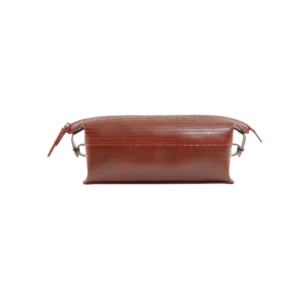
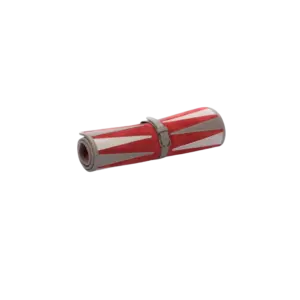
N385PA’s Tail Number Leads to the Jet, Not to the Cut That Made the Tags
Made the cut

AirlineGeeks wrote in January 2020 that each of PlaneTags’ airliner tags carries its aircraft’s tail number, “so one can actually find out when and where the aircraft the PlaneTag came from was in service.” The Pan Am 727 tag is sold under the tail number N385PA. We looked that number up, and what came back is worth setting out, because the lookup reaches the aircraft and stops before the metal.
A photograph and a date
Two aviation sites independent of the maker hold N385PA. JetPhotos files it as a Boeing 727-227, serial 20393, with a manufacture date of 12 May 1970, the day PlaneTags’ own blog gives for the aircraft’s first flight. AirHistory.net holds photo 906759, taken by Paul Seymour on 29 April 1990 at Miami International: N385PA under Pan Am titles, named Clipper Troubadour.
The two are not the same kind of evidence. JetPhotos’ registration history gives three registrations, each with a start day: N402BN with Braniff International Airways from 30 June 1970, N206US with Northwest Airlines from 28 October 1982, N385PA with Pan American World Airways from 14 March 1988. PlaneTags gives the same three days.
When a database and a maker agree on three dates to the day, and the database page we hold names no source for them, the agreement may be one line of data told twice. In our review of the record we counted JetPhotos as corroborating the maker’s dates, not as a second witness to them.
A photograph is a different kind of record: it has a photographer, a place and a day. Seymour’s picture puts this airframe in Pan Am titles at Miami in 1990, long before the maker’s November 2023 post announcing these tags.
It has a limit of its own. The photo’s caption, which follows the airframe from its Braniff delivery to its scrapping, carries no author’s name in the copy we hold; Seymour’s credit is for the photograph. On the Northwest years the caption also differs from both the maker and JetPhotos: Northwest Orient Airlines in 1982, reregistration as N206US in 1983, the airline renamed Northwest Airlines in 1986. That makes it a separate telling of the same life, which is worth having, and an unsigned one, which keeps it a caption rather than a witness.
Three endings on the maker’s own pages
After Pan Am the lookup splits. PlaneTags’ product page says the aircraft “remained in boneyard storage, still in its Pan Am colors, until 2023.” Its blog post, the one that announced these tags for release on 30 November 2023, says that after Pan Am’s closure in December 1991 the aircraft passed to other owners but stayed in outdoor storage at Smyrna/Rutherford County Airport in Tennessee for several years, and gives no end year.
The same post reproduces a photo caption credited to the photographer egcc: “N206US – 1970 built Boeing B727-227, frame scrapped at Smyrna, TN in 2013.” N206US is the registration the post itself gives this aircraft for its Northwest years.
So the maker’s own two pages carry three accounts of the end: boneyard storage until 2023, storage at Smyrna with no end given, and a frame scrapped in 2013. Two more come from outside. JetPhotos lists N385PA with Capitol Air Express from March 1993 under a status of “Str”, which its page neither spells out nor dates. AirHistory’s caption has the airframe stored at Waco, Texas in 1991 when Pan Am ceased operations, with Capital Air Express in 1993, stored at Smyrna in 1994, and scrapped in 2023.
Three of the five place the airframe at Smyrna. The record cannot settle where it stood at the end, in whose colors, or when it was cut up. And no page in the record dates the cut that made the tags, so none of the five endings can be checked against it.
Where the trail ends
No outside record reaches the cut. Everything about how the metal reached MotoArt, whose latest release the product page calls this tag, comes from the maker’s own post.
For years, it says, MotoArt owner Dave Hall and the team had known about “the Pan Am 727 and Northwest 727 aircraft at MQY”; Hall recalls numerous attempts to secure the material, none successful; then, through other relationships, he met key front-line management and privately negotiated a deal, the post never saying with whom. In Hall’s words: “Instead of ripping it apart in MotoArt fashion, we precision cut the crown”, which he says was shipped to MotoArt Studios in Torrance, California.
The Pan Am Museum Foundation’s shop, which also sells the tags, describes them as “Made exclusively from Pan Am’s beloved N385PA, Clipper Troubadour”, created by MotoArt. For how they were made, it sends its readers to the maker’s own post. That makes the shop a second voice for the claim, not a second witness to the cut.
That is where the lookup ends: the tail number documents an aircraft photographed under Pan Am titles; that a given tag’s metal came from its crown rests on the maker’s account. It is one of two reasons our review of the Pan Am 727 tag holds its WOW score at 9.5 rather than 10; the other is that the product page calls the tags limited-edition while the release post announced a numbered series of 10,000. The tag’s overall score is 8.28.
The gift study, and the doubt it leaves out
The tag’s page cites a paper by Julian Givi and Jeff Galak, first published in June 2017 in the Journal of Consumer Psychology. The authors define sentimental value as “the value derived from an emotionally-laden item’s associations with significant others, or special events or times in one’s life.”
Their research found that when givers choose between a sentimentally valuable gift and one whose surface attributes match the recipient’s preferences, they give the matching one “much more often than recipients would prefer to receive such gifts.” That asymmetry “appears to be driven by” givers feeling relatively certain the matching gift will be liked, and relatively uncertain the sentimental one will be. Three studies showed it across a variety of occasions and giver-recipient relationships, and our longer read of the three experiments walks through them.
In the two reviews of this tag we can quote, the associations are with an airline and an aircraft. Pete says he worked on this aircraft for a few years at JFK, and signs off “Gone but not forgotten”; the claim is his own. A reviewer posting as America writes that it looks great and hopes for a Pan Am comeback. Both sit on the Stamped review widget the maker runs on its own product page.
The study’s doubt is the giver’s: will it be liked? A tag sold on a tail number carries a second doubt, whether the object is what its name says, and the paper’s abstract does not take that one up. The record answers it in parts a giver can see before buying: the aircraft is documented, the cut is the maker’s word, the end is disputed.
What the study licenses is narrower. It describes givers in general, in its own three studies, never this tag; it cannot say whether a particular person would rather have this tag than something matched to their tastes, and its abstract says nothing of how much a doubt over provenance weighs in a gift.