Byron Bought Paper Here. Nobody Left a Review.
A national archive holds four photographs of their briefcase. Their own product page holds a review section with nothing in it.
Did not pass
In 1774, a stationery shop opened at Piazza della Signoria in Florence, directly across from Michelangelo’s David and the entrance to the Uffizi.
In 2026, it has zero product reviews.
Not on Amazon (no listing exists). Not on Trustpilot (no profile). Not on the brand’s own website (the product page shows a review count of zero). Not on Pen Chalet, which carries the notebooks but lists them as out of stock with no customer feedback. Not on Paul Stuart, the New York retailer that stocks them at $62.
Zero. On every platform we checked. For a product that has been in continuous production, in some form, for a quarter of a millennium.
We scored the Pineider Milano Leather Notebook 7.95. Our threshold is 8.0.
What We Found Instead of Reviews
We went looking for customer validation. We found institutional validation so specific it reads like fiction.
The G8 Summit in Genoa, 2001: the Italian government selected Pineider as the official supplier of stationery and leather goods for heads of state. The G8 Summit in L’Aquila, 2009: they were selected again.
Prime Minister Silvio Berlusconi presented President Barack Obama with a brown Pineider leather briefcase, embossed with the G8 Summit seal.
That briefcase is now in the Barack Obama Presidential Library artifact collection, maintained by the US National Archives. Artifact ID: FO.749258.1. We verified this directly. The archive page lists the manufacturer as “Pineider (Founded 1774)” and the intended recipient as “President Barack Obama.” Four photographs are on file.
D Magazine, in a 2013 feature, described Pineider as “the 240(!)-year-old Italian company” that “was the stationer of choice for authors and poets the likes of Lord Byron, Percy B. Shelley, Elizabeth Barrett Browning, and Charles Dickens.” The article called the stationery “seriously gorgeous.”
Pen Chalet’s brand page confirms the founding date and notes that Pineider “caters to Royals, Artists, Industrialists, and Governments all over the World.”
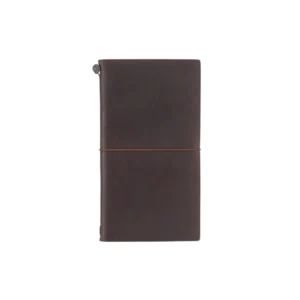
The notebook itself: soft saffiano leather cover, hand-painted edges in the Florentine tradition, 192 pages of 80gsm watermarked ivory laid paper, hot-stamped Pineider logo, ribbon bookmark. Made in Italy. Eleven color options. The product page offers paid customization (initials or text) for €10. It costs €49 from pineider.com, about $54 at current exchange rates. Paul Stuart lists it at $62.
The Scores
GLOW scored 9. The hand-painted edges are not decorative language. Each edge of the leather cover is painted by hand, color-coordinated to the leather. Saffiano texture catches light without being ostentatious.
Eleven colors, from Pineider Green to Midnight Black to Turchese. The aesthetic is restrained Italian luxury: no over-branding, no unnecessary hardware, just materials and craft.
WOW scored 8. A notebook from the brand that supplied Obama’s G8 briefcase, for $54. The gap between what you’re holding and what people assume about a $54 notebook is the discovery.
In our judgment, the person who receives this is unlikely to have seen it before.
MOMENT scored 8. Saffiano leather softens with daily use. Ivory laid paper accepts fountain pen ink without feathering. The ribbon bookmark, the watermark visible when you hold a page to light, the weight of the cover in hand. The brand story, told at the moment of giving, carries 252 years of provenance in a single object.
TRUST scored 6.0.
This is the problem.
Our confidence score was 60 out of 100. The institutional evidence is extraordinary: verified G8 credentials, a presidential archive entry, 252 years of documented operation, editorial coverage, multiple US retailers stocking the product. But our Evidence Checklist measures consumer validation.
Platform integrity: 8 out of 20 (brand site only, no third-party review platform). Review volume: 8 out of 20 (zero reviews anywhere). Source quality elevated to 17 out of 20 under our Brand Trust Protocol, which adds weight for verified institutional relationships. Claim verification: 14 out of 20 (product claims confirmed, heritage claims confirmed across multiple sources). Temporal consistency: 13 out of 20 (252-year brand history, but no consumer data to track over time).
Trust score is derived: 60 divided by 10 equals 6.0.
The weighted formula: (9 × 0.25) + (8 × 0.35) + (8 × 0.25) + (6.0 × 0.15) = 2.25 + 2.80 + 2.00 + 0.90 = 7.95.
We needed 8.0.
The Paradox
Pineider’s primary buyer is, almost certainly, the person who does not leave online reviews. Luxury stationery collectors, professionals buying client gifts, travelers who walk past Piazza della Signoria and step inside. They buy on heritage, on provenance, on the weight of the paper in their hand.
Not on star ratings.
Our system is designed to protect gift-givers from making a bad purchase. It does this by requiring evidence: reviews, ratings, verified buyer feedback, external discussion. The Pineider Milano Notebook has none of these things.
What it has is a briefcase in the National Archives, a founding date older than the United States, and the confirmed patronage of a list of names that reads like a humanities syllabus.
The evidence is real. It is verifiable. It is, in some ways, more rigorous than a star rating (you cannot fabricate an entry in the Obama Presidential Library). But it is not the kind of evidence our system is built to measure.
What Would Change
Consumer reviews on any platform would shift the confidence score. The institutional evidence already clears every other threshold. A review base, even a modest one, would provide the consumer signal our system requires to complement the institutional signal that is already verified.
The product page on pineider.com has a review section.
It is empty. If it were not empty, this would be a different conversation.
We verified a briefcase in the National Archives. We confirmed a founding date from 1774. We traced the patronage of Byron and Shelley to their documented periods in Florence. We checked every major review platform and found nothing. The Pineider Milano Leather Notebook is, by institutional credential, the most verified product we have ever rejected. By consumer credential, it is the least.